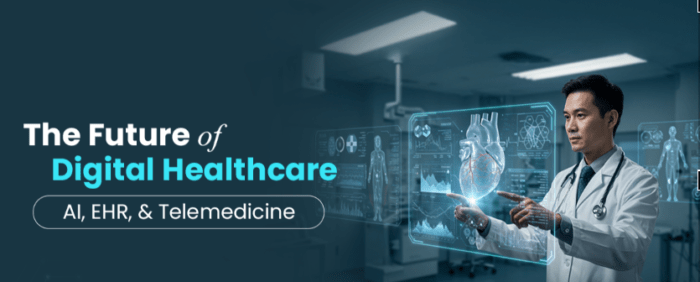
The Future of Digital Healthcare: AI, EHR, and Telemedicine
Digital Healthcare is undergoing a great transformation driven by technologies like AI, EHR (Electronic Health Records), and Telemedicine. Now, hospitals generate and access vast amounts of patient data, but turning this data into timely, precise clinical decisions remains a challenge. Information often seems disconnected, slowing workflows and also limiting the ability of clinicians to deliver truly personalized care. The gap is not about the absence of technology, but how effectively the digital tools are supporting the precision in healthcare, where decisions are quite accurate, contextual, and made at the right moment. When AI, EHR, and Telemedicine work together as a unified & integrated system, then there is much faster, cleaner, and more patient-centric healthcare delivery.
In this comprehensive blog, we will explore how these connected digital healthcare shaping the future of precise healthcare, and what it takes to transform complex systems into meaningful outcomes for both the patients and providers.
AI in Healthcare Practices: Automation to Augmented Intelligence
The use of AI, particularly Generative AI, has become very demanding and is evolving at a rapid rate. It can enhance the healthcare outcomes to give some great improved results, whether it is in clinical trials, medical diagnosis, or in any personalized care system.
In the case of regulations, AI also speeds up the process that enables better compliance and quality establishment. As per WHO released publication on regulatory considerations, it has given significance to establishing the safety & effectiveness, which is rapidly making some availability to those who need them and also transforming seamless communication along with that.
High-Impact Ways AI Supports Clinical Decision-Making
- Early Disease Detection
- Predictive Risk Scoring for complications in the healthcare operations
- Intelligent Triage and Prioritization in Emergency Care
For example, AI models can assess thousands of clinical variables to flag high-risk patients long before symptoms tend to escalate. This transforms care from reactive to a preventive & proactive one.
1. Pro Insight: Making AI Work Inside Clinical Workflows0
So, in the healthcare systems, it has been generally observed that AI is most successful when it is able to integrate with the existing workflows rather than any kind of standalone system or healthcare dashboard. And the AI in healthcare that requires extra clicks or context switching often fails in adoption despite accuracy.
2. EHR Practices: Evolving from Record Keeping to Smart Intelligence
The future of EHR lies in true interoperability and is changing the narrative of healthcare processes. The global EHR market size was estimated at $33.43 billion in 2024 and is expected to reach around $43.36 billion by 2030 at a CAGR rate of 4.5% from 2025-2030. This dynamic growth signifies that EHRs are no longer record-keeping tools, but are becoming the next foundation for smarter decisions that is powered by AI & connected care.
How AI Enhances Clinical Decision-Making Within EHR Systems
- Surface relevant patient history automatically
- Summarizes long clinical notes into actionable insights
- Detects gaps in patient care or missed follow-ups
- Supports real-time decision making
The EHRs tend to become a great aspect in the healthcare development process and create a total shift in the healthcare priorities that results in totally data-driven growth. The integration of EHR for the healthcare industry tends to enhance efficiency, accuracy, and patient outcomes. Here, AI streamlines repetitive administrative functions such as data entry, billing, and coding. EHRs are designed as digital filing cabinets, and over time, they become billing engines, compliance tools, and administrative systems, often at the expense of clinical experience.
EHR systems offers most value when they actively support the people using them. And, when they are combined with AI agents, they become especially effective for EHR software healthcare providers who are able to manage the larger volumes of patient data and also complex care workflows every day. AI-powered featured agents that are associated with the EHR system help in transcribing complex things to simple things, which is very easy to understand, offers seamless patient and clinician notes in real-time, totally changing the he.
Additionally, blockchain technology is also equally integrated into the future of the healthcare system with the collaboration of EHR systems. EHR systems are reshaping the future of patient care, bringing powerful tools that enhance our care quality in the healthcare processes. The EHR platforms that succeed in 2026 will be clearly those that are designed for adaptability, supporting intelligence and patient care centered on scaling productivity in work processes.
1. Pro Insight: What to Look for When Upgrading Your EHR
While you evaluate or upgrade EHR, you can prioritize systems that mainly summarize the patient key information and automatically fit naturally into the daily work processes.
2. Telemedicine: Shifting from Virtual Visits to Intelligent Care Ecosystems
Telemedicine adoption mainly took up the spotlight during the pandemic, but the initial wave focused largely on accessibility, not only on outcomes. In 2026, telemedicine transitioned from an emergency situation to a strategic foundation for the healthcare systems. It is integrated into a hybrid care model with the proper blending of digital consultations with a traditional approach that helps in improving patient accessibility and outcomes.
This great evolution has placed technology at the core of the care delivery process, ensuring the purpose-built telemedicine platforms are essential for ensuring continuity of care and also a consistent patient experience across digital touchpoints, strongly backed by the WHO’s guidance on making telehealth services accessible.
Telemedicine can be said to be the usage of digital communication technologies, such as video conferencing, mobile apps, and remote monitoring devices that offer medical services and consultations on a remote basis. This approach allows the patients to receive great medical care from the comfort of their homes, eliminating the need for physical visits to the clinics.
How Telemedicine Is Expanding Beyond Virtual Consultations
- Remote patient monitoring through wearables & IoT Devices
- Chronic Disease management programs
- AI-assisted symptom checkers and support
- Post-discharge follow-ups aligned to patient data
So, while telemedicine is properly aligned with EHRs, clinicians gain a longitudinal aspect of patient health rather than any fragmented information. Telemedicine, with its enhanced continuity of care, facilitates seamless communication among patients and healthcare services.
Pro Insight: Making Telemedicine a Natural Extension of Clinical Care
You should use telemedicine as part of the care workflow, not like any separate channel flow. While you select platforms that sync with EHRs, so patient data, visit information, and follow ups into a unified record without any manual workflow.
Conclusion
So, overall, the future of digital healthcare will not define how tools are adopted, but how many tools are, that the system can adopt. Technologies like AI, EHR, and Telemedicine are the most effective ones in the healthcare aspects that are able to support better decision making, reducing friction, and also strengthen the connection between the patients and healthcare teams.
Healthcare organizations that succeed in the coming years will focus less on technology and more on outcomes. There will be investment in systems that integrate data, fit the right workflows, and also put clinicians & patients at the first priority. This shift requires thoughtful planning, clear-cut priorities, and also experts who understand the healthcare complications along with digital designs.