Beyond Chatbots: How AI Agents Are Creating Opportunities for Startups
I have seen that artificial intelligence is no longer about answering questions or writing text. In years businesses have become accustomed, to artificial intelligence chatbots. These artificial intelligence chatbots can answer customers provide information and help with tasks.
Now technology is moving one step further.
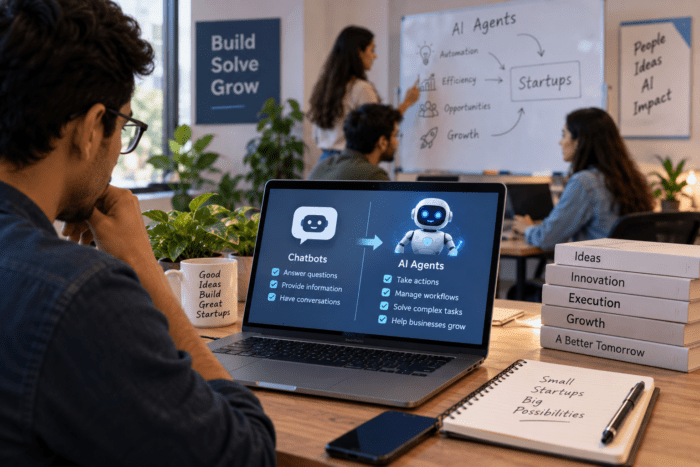
AI agents are opening possibilities for businesses and startups. They help perform tasks, manage workflows, analyze information and reach goals. By waiting for a question and providing an answer AI agents can be designed to carry out a set of actions guided by instructions and predefined rules.
This shift is creating opportunities for startups in industries, such as customer service, sales, software development, agriculture, finance and business operations.
The future of AI may not be about building chatbots. It may be about creating AI agents that can help people accomplish work.
What Are AI Agents?
An AI agent is a software system made to work toward a goal.For example, imagine asking an AI system to find customers, research their businesses, organize the information, prepare outreach and update a database.
A traditional chatbot might explain how to finish these tasks.
An AI agent, based on its design, tools, permissions and level of oversight can help perform many steps in that workflow. This is one of the differences between a chatbot and an AI agent.
A chatbot is mainly made for conversation. An AI agent is made to support action and complete tasks.
For startups this difference creates a business opportunity. By building general AI tools they can create solutions that solve problems faced by particular industries or types of businesses.
Why AI Agents Are Important for Startups
Startups often work with resources. A small team may need to handle marketing, sales, customer support, research, administration and daily operations at
A growing startup can benefit from small productivity gains that AI agents bring.Entrepreneurs have an opportunity to do more than just build an AI-powered product.
It is to find a problem and to decide if an AI agent can solve it in a manner..
Moving Beyond Simple Conversations
Traditional chatbots usually follow a pattern. A customer asks a question. The chatbot gives an answer.
Common Customer Questions
- Where’s my order?
- What is your returns policy?
- How do I get hold of customer support?
AI agents can handle workflows. Imagine a customer saying an order has not arrived. An AI agent could be set up to check the order status, review shipping details, spot problems and suggest solutions. Hand the case over to a human support representative when needed.
The key difference is that the system does more than just give information. It participates in a process.
This ability to support -step workflows is one reason AI agents are gaining attention from startups and established businesses.
Building AI Agents for Specific Industries
One of the opportunities for startups is creating industry- AI agents. Every industry has its processes, words, challenges and customer needs. A general AI assistant may not always understand these details.
1. Real Estate
For instance, an AI agent built for the real estate industry could help organise leads, schedule property visits and follow up with buyers.Manage customer data.
2. Healthcare
A healthcare AI system could help with workflows while staying within privacy, safety and professional constraints.
Dedicated healthcare AI tools could help with workflows but would be limited by privacy, safety and professional regulations.
3. Legal
I believe that legal AI assistant can organize documents. Legal AI assistant can also summarize information and support professionals with research and drafting tasks.
I believe that legal AI assistant can organize documents. Legal AI assistant can also summarize information and support professionals with research and drafting tasks.
The real value comes from combining AI capabilities with an understanding of the industry being served.
The real value comes from combining AI abilities with an understanding of the industry being served.
AI Agents for Customer Support
Customer support is one of the applications of AI agents. Businesses receive a number of customer questions every day. While some issues are simple others require information from systems.
A designed AI agent can help support teams by handling parts of the process.
What AI Agents Can Help With
For example it could:
- Check order information
- Review previous customer interactions
- Identify common issues
- Provide information
- Suggest possible solutions
- Create or update support tickets
- Escalate cases to a human employee
For example it could: Check order information. Review past customer interactions. Identify issues. Provide information. Suggest solutions. Update support tickets. Escalate complex cases to an employee.
For startups this creates opportunities to build AI solutions for industries such as e-commerce SaaS, travel, education and professional services.
For startups this creates chances to build AI solutions for industries such as e-commerce SaaS, travel, education and professional services.
However the goal should not be to remove support. Customers should still have access to a person when a problem is complex or requires judgment.
However the goal should not be to replace support. Customers should still have a person when a problem is complex or needs judgment.
AI Agents for Sales and Lead Management
Sales teams spend an amount of time on activities that are not directly related to speaking with customers.They research companies organize leads, update CRM systems and prepare outreach messages. Follow up with prospects.AI agents can help reduce some of this workload.
Sales teams spend a lot of time on activities that’re not about talking with customers. They research companies organize leads, update CRM systems and prepare outreach messages. Follow up with prospects. AI agents can reduce some of this admin work.
Sales Tasks AI Agents Can Support
For example a sales-focused AI agent could research information about a company, summarize relevant details, organize lead information and help prepare personalized communication.
For example a sales-focused AI agent could research information about a company, summarize key details, organize lead data and help prepare messages.
This could be particularly useful for startups that want to improve their sales processes without immediately building a large sales team.However businesses should avoid using AI to send volumes of generic messages.The best use of AI in sales is likely to focus on improving research organization and personalization while allowing people to remain involved in conversations and relationship-building.
This can be especially useful for startups that want to improve their sales processes without building a large sales team. However businesses should not use AI to send generic messages. The best use of AI in sales is likely to focus on research organization and personalization while letting people stay involved in conversations and building relationships.
AI Agents for Internal Business Operations
Not every AI startup needs to build a product that customers interact with directly. There is also an opportunity to improve business operations.
Common Business Tasks
Many companies spend hours every week on tasks such as:
- Entering and organizing data
- Preparing reports
- Managing documents
- Summarizing meetings
- Scheduling tasks
- Processing requests
- Conducting research
- Updating internal systems
Many companies spend hours each week on repetitive tasks such as: entering and organizing data. Preparing reports. Managing documents. Summarizing meetings. Scheduling tasks. Processing requests. Conducting research. Updating systems.
AI agents can help businesses automate parts of these workflows. For example an AI agent could collect information from approved business systems, organize data and prepare a report for a manager to review.
AI agents can help businesses automate parts of these workflows. For example an AI agent could gather information from approved business systems, organize data and prepare a report for a manager to review.
The final decision can still remain with a human. For startups, solving one internal workflow can create a valuable product. A business does not necessarily need an AI assistant. It may simply need a way to complete one task.
The final decision can still stay with a human. For startups, solving one internal workflow can create a valuable product. A business does not always need an AI assistant. It may just need a way to finish one task.
AI Agents as a Service
Another growing opportunity is offering AI agents as a service. Many sized businesses understand the potential benefits of artificial intelligence but they may not have an in-house AI team or the technical knowledge required to develop their own systems.
Another growing opportunity is offering AI agents as a service. Many small businesses and medium businesses know that AI can help them. They might not have a team, inside their company that works with AI. They might also not have the skills needed to create their systems.
Startups can help fill this gap.By asking businesses to build an AI solution from scratch a startup can offer a to-use or customized AI agent designed for a specific business function.
Startups can fill this gap. By asking businesses to build an AI solution from scratch a startup can offer a ready-to-use. Customized AI agent made for a specific business function.
Example Uses
For example a company might use an AI agent to:
- Manage customer inquiries
- Organize sales leads
- Prepare business reports
- Handle tasks
- Monitor internal workflows
For example a company might use an AI agent to: manage customer inquiries. The AI agent can help keep customers happy and save time.Organize sales leads. Prepare business reports. Handle tasks. Monitor workflows.
This model can make AI technology more accessible to businesses that do not have the resources to develop their systems.For startups subscription-based services may also provide opportunities to build long-term customer relationships.
I believe this model can make AI technology more accessible, to businesses that lack the resources to build their systems. I also see that for startups, subscription-based services may offer chances to build long-term customer relationships.
AI Agents Are Creating Opportunities in Software Development
I have seen that Software development is an area where AI agents are starting to change workflows. Developers already use AI for coding help, debugging, testing and documentation.
AI Agents in Development Workflows
AI agents could support development processes by helping connect multiple tasks. For example an AI agent could help analyze a bug report, identify sections of a codebase, suggest possible solutions, generate test cases and prepare documentation for review.
AI agents could help with development processes by linking multiple tasks. For example an AI agent could analyze a bug report, find parts of a codebase, suggest solutions, generate test cases and prepare documentation for a human to review.
Human developers will still play a role.Software architecture, security, quality control and complex technical decisions require experience and careful judgment.
Human developers will still be essential. Software architecture, security, quality control and complex technical decisions need experience and careful judgment.
However AI agents can help reduce the time spent on development tasks.This creates opportunities for startups to develop tools for developers, engineering teams and technology companies.
However AI agents can cut the time spent on development tasks. This creates chances for startups to create tools for developers, engineering teams and technology companies.
AI Agents in Agriculture and Rural Businesses
Agriculture is another sector where AI agents could create opportunities. Farmers and agricultural businesses often need to manage types of information including weather conditions, crop planning, equipment maintenance, market updates and daily farm activities.
Agriculture is another sector where AI agents could create opportunities.Farmers and agricultural businesses often have to handle types of information. They need to keep track of weather conditions plan crops manage equipment maintenance stay updated on market prices and handle farm tasks. Gathering and organizing all this information can be time-consuming.An AI agent designed for agriculture could help simplify some of these processes.
Getting and organizing this information can take time. An AI agent made for agriculture could help simplify some of these tasks.
For farmers, keeping track of tractor use, maintenance schedules and other equipment-related information can also become part of these digital workflows.
Platforms such as KhetiGaadi can make all tractors and farming-related information easier for farmers to find when they are making equipment decisions. Artificial intelligence is no longer about answering questions or writing text. In years businesses have grown used to AI chatbots that can reply to customers share information and assist with tasks.. Now the story is changing. Beyond chatbots AI agents are stepping in. These are more advanced. They can make decisions take action and work, on their own. For startups this opens up opportunities. They can build tools that automate complex workflows. They can create systems that learn and adapt. This means startups don’t need teams to get started. They can use AI agents to do the lifting. It’s not about talking anymore. It’s about doing.. That change is giving new life to small companies. Startups can now compete in ways they couldn’t before. AI agents are not a tool. They are a game changer.
As AI agents grow powerful businesses must think carefully about how to give control to automated systems.
An AI agent can access customer information, business records, financial data or internal tools. If the system makes a mistake the consequences could be serious. That is why human oversight remains important.
Businesses Should Clearly Define
- Which tasks the AI agent can perform.
- Which actions require approval.
- What information the AI agent can access.
- How the AI agent’s activities are monitored.
- How mistakes by the AI agent can be. Corrected.
The future of AI agents should not be about giving technology control. In cases the best approach will combine AI automation with decision-making.
Startups that build transparency, security and user control into their products may have an advantage.
The Real Opportunity Is Solving a Specific Problem
The growing popularity of AI agents has encouraged businesses to add AI features to their products.
However, adding AI does not guarantee that a product will be useful. The successful startups will likely begin with a problem rather than with technology.
Of asking: “How can we build an AI agent?”
Startups can ask: “What problem can we solve effectively with an AI agent?”
Questions Startups Can Ask
For example:
- Can an AI agent reduce the time required to respond to customers?
- Can an AI agent help a small business manage sales leads?
- Can an AI agent simplify an administrative process?
- Can an AI agent help employees organize amounts of information?
- Can an AI agent support farmers and agricultural businesses with tasks?
These questions focus on value. Technology is important. The real success of an AI startup will depend on whether people find the solution useful.
Challenges Startups Should Consider
Although AI agents offer opportunities, startups also need to prepare for challenges.
1. Data Privacy and Security
AI agents may require access to business or customer information. Startups need to consider how data is accessed, processed, stored and protected.
2. Reliability
AI systems can make mistakes or misunderstand instructions. A system that works well most of the time may still create problems if it fails during a task.
3. Cost
Operating advanced AI systems can be expensive. Startups need to ensure that the value provided to customers is greater than the cost of running the service.
4. Integration
Businesses already use software platforms for sales, customer support, finance, communication and operations. The AI agent becomes more useful when it can work effectively and securely with existing systems.
5. Building User Trust
- People are more likely to use AI tools when they understand what the AI agent is doing and maintain control over decisions.
- Startups that address these challenges successfully could create long-term opportunities.
What Could the Future of AI Startups Look Like?
- The chatbot era showed businesses that AI can communicate with people. AI agents are showing that artificial intelligence can also participate in workflows.
- In the coming years we may see startups developing AI agents for specific industries and professional roles.Some may support sales teams.
- Others may help customer service representatives, software developers, farmers, researchers, marketers or small business owners.
- The successful companies may not necessarily be the ones building the AI models.
- Instead they may be the companies that understand a group of users and solve a problem better than anyone else.
- A simple and reliable AI agent that saves a business hours every week may be more valuable than a system with dozens of features that nobody needs.
- AI agents are taking intelligence beyond conversations. By answering questions these systems can be designed to support workflows, manage tasks, organize information and help people work toward specific goals.
For startups this creates opportunities in every industry.
From customer support and sales to software development, agriculture and internal business operations companies are searching for ways to reduce work and improve productivity.
However successful AI startups will need to focus on more than technology.
They will need to understand their users, solve problems, protect data, create systems and maintain the right level of human oversight.
The next generation of startups may not be the ones that simply create another chatbot.
They may be the companies that discover how AI agents can solve problems in reliable and meaningful ways.
Frequently Asked Questions
What is the difference between an AI agent and a chatbot?
A chatbot is mainly designed to communicate and answer questions. An AI agent can be designed to work toward a goal by planning steps using tools and supporting the completion of defined tasks.
Why are AI agents creating opportunities for startups?
AI agents can help automate tasks, improve business workflows and create solutions for different industries. This gives startups opportunities to solve problems for businesses and consumers.
Which industries can benefit from AI agents?
AI agents can be useful in customer service, sales, software development, agriculture, education, real estate, finance, logistics and many other industries.
Can AI agents replace employees?
AI agents can automate tasks. Human involvement remains important for decision-making, creativity, complex problem-solving and situations that require professional judgment.
How can AI agents help the agriculture sector?
AI agents can potentially help farmers and agricultural businesses organize information, manage tasks, track equipment maintenance, access data and simplify routine farming-related activities.
What should startups focus on when building AI agents?
Startups should begin by identifying a problem. They should also focus on reliability, security, data privacy, cost, integration, user experience and appropriate human overs.