Why Custom Software Development Delivers Better Long-Term ROI
For a growing business, buying commercial off-the-shelf software is often the safest, quickest way to go. It’s easy to set up, and the monthly user fees look modest on the budget sheet. Deployment takes days, not months. But as business operations grow, that early convenience often becomes a subtle financial drag. Subscription tiers grow, technical workarounds multiply, and inflexible software frameworks require internal teams to change their proven workflows to match what the vendor built.
The cost-conscious decision can slowly turn into an expensive cycle of recurring license payments and lost productivity. Custom software development changes that whole financial dynamic. Customized platforms require a larger initial capital commitment but deliver long-term enterprise value by eliminating recurring licensing costs, simplifying core operations, and evolving with changing business priorities.
The Total Cost of Ownership Misconception
Evaluating the true financial return on technology investments requires looking well beyond initial setup expenses. Many executives calculate software costs using a simplified formula: monthly subscription fees multiplied by total team headcount. Unfortunately, this basic arithmetic ignores the compounding expenses built into commercial software models.
Commercial software providers build their business frameworks around ongoing monetization. As an organization hires more employees, accesses advanced feature sets, or exceeds basic data processing limits, platform fees escalate quickly. On top of that, vendor price adjustments, tier restructurings, and unexpected feature deprecations regularly alter financial predictions without warning.
Beyond direct subscription receipts, generic platforms introduce hidden operational drains-
- Unused Feature Inflation- Companies frequently pay for massive feature suites where employees only utilize a small fraction of the tools provided.
- Fragile Workaround Costs- When normal platforms lack certain features, internal developers are left with no option but to spend time developing glue code.
- Vendor Lock-In Risk- The process of transitioning to another platform becomes harder for the business over time, resulting in a significant increase in the cost of renewing their contracts.
Building custom platforms eliminates all such periodic costs. After launching the application, costs go from increasing subscription rates to infrastructure hosting and feature development.
Eliminating Operational Friction and Manual Workarounds
Commercial applications are engineered for mass market reach. To serve thousands of distinct enterprises across different sectors, packaged tools impose broad, standardized workflows. When a company attempts to squeeze its unique, high-performing processes into a rigid software shell, operational efficiency drops.
Employees end up juggling multiple disconnected tools, manually moving data across disparate tabs, and managing side spreadsheets to track vital operational details. These daily friction points quietly erode worker productivity and increase error rates across high-volume business activities.
| Operational Criteria | Off-the-Shelf Commercial SaaS | Custom Built Platform |
| Workflow Alignment | Generic, pre-configured tasks | Native, process-aligned design |
| Data Flow | Manual cross-system entries | Automated end-to-end integration |
| Expense Structure | Perpetual per-user subscription fees | One-time build, owned balance sheet asset |
| Platform Control | Dictated entirely by third-party vendor | Managed internally based on core priorities |
Teamwork with a professional software development company ensures the technological solution aligns with your processes rather than changing them. Designing a system that aligns with employees’ duties directly eliminates excessive menus and reduces the time needed to complete any task.
Unifying System Architecture and Reducing Technical Debt
Today’s business technology stacks are often a patchwork of specialized applications. A company might be using one tool for sales leads, another for project tracking, a third for inventory management, and a fourth for reporting. Maintaining these isolated apps and keeping them talking to each other takes continuous upkeep.
Heavy reliance on third-party integration pipelines creates operational risk. When a software vendor alters application interfaces or changes the underlying code structure, downstream connections can unexpectedly break, halting work and necessitating emergency IT support.
Investing in tailored digital transformation services allows organizations to design unified software platforms from the ground up. Instead of patching together incompatible external platforms, a central custom system processes, stores, and organizes operational data inside a single secure environment.
Building a unified architecture delivers clear financial benefits-
- Lower Support Overhead- Maintaining a single tailored core platform reduces system breakages, lowering long-term maintenance expenses.
- Immediate Data Access- Centralized data storage provides executive teams with reliable operational insights instantly, without relying on complex export scripts.
- Stronger System Defense- Reducing reliance on external software connectors minimizes digital attack surfaces, simplifying security compliance and data audits.
Transforming Software Spend into Balance Sheet Assets
The core difference between subscribing to commercial software and building custom platforms lies in equity creation. Monthly payments for off-the-shelf tools are pure operating expenses. When a contract ends or a vendor changes terms, the money spent yields no lasting value.
Conversely, engaging professional custom software development services turns software spending into proprietary intellectual property. An application designed around your business logic sits directly on your company balance sheet as an intangible asset.
Owned technology infrastructure generates distinct commercial advantages-
- Direct Market Differentiation- Unique digital tools, custom client portals, and automated workflows enable companies to deliver customer experiences that competitors using generic tools cannot mirror.
- Higher Enterprise Valuation- Investors and acquirers consistently place higher financial valuations on firms that own their underlying technology stack rather than relying entirely on third-party subscriptions.
- New Revenue Opportunities- Well-designed internal platforms can eventually be adapted, white-labeled, or licensed to generate fresh subscription revenue from adjacent market segments.
Owning your codebase guarantees complete independence. You choose when to update features, how sensitive information is stored, and where servers are hosted – protecting your business from vendor price shocks or platform shutdowns.
Scalability and Future-Proofing for Modern Operations
As the organization grows, its requirements change very quickly. A system that is good enough for a few people will prove inadequate under more challenging conditions, such as high transaction volume, regional compliance requirements, or complex database queries.
When commercial tools hit performance limits, providers usually push businesses toward enterprise tiers that carry heavy recurring price increases. Hidden scaling costs and unexpected integration needs often push the total cost of enterprise SaaS platforms to double or triple their original contract estimates over five years.
In contrast, modern custom application development leverages modular, cloud-native frameworks – such as microservices and event-driven data flows – that scale effortlessly alongside operational growth. Working alongside a capable software development company lets organizations adopt emerging technologies on their own schedule, keeping platforms modern without requiring complete system overhauls.
Breaking the Headcount Tax – How Subscription Fees Multiply as You Scale
Assessing the real financial impact of technology requires looking past the first-year setup budget and examining long-term cash flow patterns.
While building a tailored platform demands a higher initial capital commitment, the ongoing cost structure behaves very differently from commercial software. Off-the-shelf SaaS providers rely on per-user subscription models. When your company expands from 20 employees to 200, your software licensing costs multiply automatically – even if the underlying software isn’t delivering any additional value.
Moreover, employees who are coerced to use generic tools that do not match their job requirements will end up wasting several hours on such solutions, managing manual workarounds and duplicate data entry. This negatively impacts the efficiency of the work process.
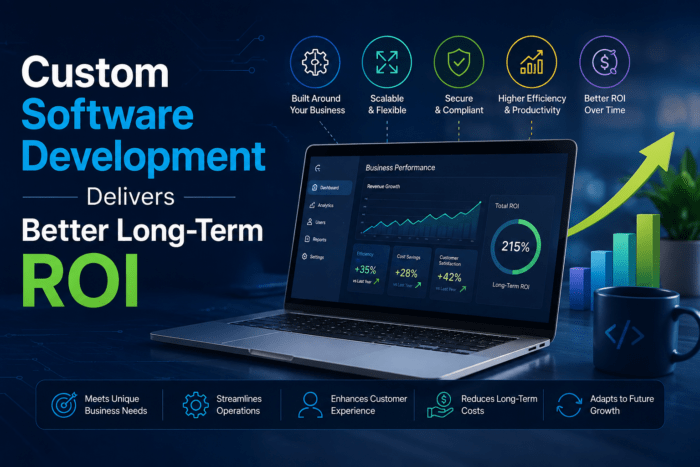
Building tailored software eliminates this recurring “headcount tax”. Once your core application is deployed, adding new users requires zero extra licensing fees. Over a multi-year horizon, avoiding compounding subscription bills and reclaiming lost employee hours makes bespoke software significantly more cost-effective.
Concluding Thoughts
Deciding between packaged commercial tools and custom software comes down to a fundamental choice – renting temporary convenience or building permanent enterprise value. While commercial platforms offer a quick starting point for simple tasks, they eventually create financial and operational caps for expanding businesses.
Custom platforms eliminate subscription inflation, match internal business logic precisely, and convert technology spending into valuable intellectual property. For forward-looking organizations aiming to build a lasting operational edge, custom software development remains one of the most reliable long-term investments available.