How AI Is Transforming Software Quality Engineering
Software quality engineering faces an unprecedented operational shift as enterprise deployment cycles accelerate from months to daily releases. Quality assurance teams can no longer maintain delivery velocity using legacy manual execution or brittle automation scripts. Integrating AI in software testing frameworks converts quality management from an execution bottleneck into a strategic business driver.
Enterprise leaders allocate significant capital to software testing. Adopting intelligent verification systems reduces post-release defect costs, eliminates repetitive script upkeep, and accelerates product delivery across modern engineering pipelines.
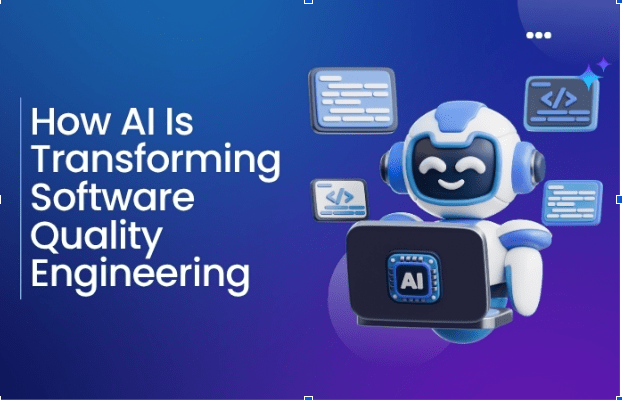
The Operational Transition to Autonomous Verification
Software delivery schedules now operate in continuous cycles rather than quarterly milestones. Delivery teams deploy code updates daily, making traditional manual verification an operational bottleneck.
Industry data shows 89% of technology organizations currently pilot or deploy generative workflows in quality operations. Moving from isolated pilots to full enterprise architecture requires structured alignment across engineering teams.
Adopting AI in software testing allows organizations to streamline continuous delivery pipelines. Strategic frameworks outlined in studies covering AI in QA demonstrate how structured deployment prevents execution friction across engineering teams.
Financial Metrics and Return on Investment of AI in Software Testing
Defects identified late in production environments create significant financial liabilities. Data from the IBM Systems Sciences Institute indicates that remediating a production defect costs 15 times baseline requirements-stage estimates.
Legacy automation suites incur heavy maintenance costs. Test script repairs consume 25% to 50% of annual quality budgets. Unstable, flaky test scripts absorb 16% of continuous integration execution time in large enterprise software environments.
Implementing a modern AI Testing solution restructures operational costs by reducing manual maintenance dependencies. Enterprise organizations reaching mature implementation realize an average 187% return on investment over 24 months. These organizations achieve faster release execution, higher defect detection, and accelerated time-to-market.
| Performance Category | Legacy Verification Frameworks | AI-Enhanced Verification Systems | Measured Financial & Operational Outcome |
| Production Defect Remediation | Costs escalate post-release | Catches logic errors early in execution pipelines | Reduces post-release patch costs and emergency downtime |
| Automation Suite Upkeep | Consumes substantial engineering time | Dynamically updates scripts during interface changes | Redirects engineering capacity toward product development |
| Regression Cycle Time | Constrained by manual validation and execution delays | Accelerates test suite execution speed | Delivers rapid feature deployment to production |
| Enterprise Investment Return | Yields incremental, localized cost savings | Generates strong multi-year financial returns | Establishes a long-term competitive operating advantage |
Core Technological Mechanisms of AI-Driven Test Automation
Modern engineering architectures integrate intelligent algorithms across three distinct technical functions to optimize AI-Driven Test Automation.
Dynamic Locators and Self-Healing Automation
Modifications to application user interfaces routinely break traditional selector paths. Automated self-healing test automation solves this instability by tracking DOM attributes, visual positioning, and object trees simultaneously. When element identifiers change, the script dynamically identifies the correct element, updates its internal locator map, and continues execution without triggering false failures.
Requirements Parsing and Script Generation
Generative models convert plain language business requirements directly into executable test code. Automated AI test case generation extracts user flows from Jira user stories or natural language descriptions, constructing structured functional test scripts for frameworks like Playwright and Selenium. This approach cuts manual test authoring time by more than 50%.
Risk-Based Predictive Execution
Executing complete regression suites for minor code adjustments creates unnecessary compute costs and delays feedback loops. Systems utilizing predictive testing analyze source code commits, historical defect records, and system logs to determine high-risk modules. The execution engine prioritizes high-risk test paths, delivering rapid feedback to development teams.
Operational Maturity Levels in Quality Engineering
Organizations evaluate testing capabilities through a six-tier maturity framework. Level 0 relies on purely manual human execution. Level 1 introduces script generation assistants, and Level 2 incorporates isolated visual validation tools. Level 3 connects automated suites directly to continuous integration pipelines, though human engineers still perform manual script repairs.
AI-Enhanced Software Engineering reaches higher efficiency at Level 4 and Level 5 maturity. Level 4 systems deploy self-healing scripts and predictive defect analytics proactively. Level 5 establishes autonomous verification where intelligent AI agents navigate software interfaces independently.
Agentic verification workflows utilize the Model Context Protocol (MCP) to coordinate multi-system interactions. Independent software agents analyze requirements, construct test suites, execute interactions across distributed environments, and deliver root-cause analysis reports directly to engineering leads.
Mitigating Implementation Challenges
Enterprise adoption introduces specific technical and operational challenges that leaders must manage.
| Primary Operational Challenge | Identified Industry Root Cause | Strategic Mitigation Approach |
| Data Privacy and Leakage Risks | Accessing proprietary databases with external models | Deploy private instance models and synthetic data masking |
| Architectural Integration Barriers | Legacy software frameworks lacking open APIs | Utilize standardized agentic protocols like Model Context Protocol |
| Output Reliability and Hallucinations | Non-deterministic generative model behaviors | Maintain strict human-in-the-loop verification protocols |
| Internal Engineering Skills Deficit | Lack of machine learning and prompt engineering skills | Partner with enterprise software verification specialists |
Security protocols have adapted to these operational risks. The proportion of organizations conducting security evaluations before deploying testing tools rose from 37% in 2025 to 64% in 2026.
Actionable Roadmap for Executive Leaders
Adopting AI in software testing requires engineering leaders to follow a structured roadmap to capture sustainable value from automated verification investments. Integrating continuous validation early in development establishes a shift-left operational culture. Initial implementation focus should target high-volume regression suites and visual validation tasks to build immediate operational confidence.
Human engineering oversight remains necessary for validating complex business logic, security permissions, and overall user experience quality. Organizations aligning operational execution with disciplined quality governance achieve faster market delivery while protecting enterprise brand reputation.