AI Mobile App Development Trends Businesses Should Watch in 2026
A business owner we know spent eleven months building a loyalty app with a punch-card system. When it was released, two of his competitors were already launching apps that looked at users ordering history and uses recommendation engine to suggest discounts on their preferred item. He didn’t lose because his app was bad. He lost because he built for a version of 2024 that had already quietly ended.
We’re not here to sell you on AI for the sake of it. We went through what’s actually ranking on this topic, what McKinsey and Gartner are measuring, and what business owners keep asking their agencies right now instead of what a developer blog assumes they want to know.
And it’s worth saying upfront: McKinsey’s most recent State of AI research found 88% of organizations now use AI in at least one business function, yet only around 6% count as genuine “high performers” who can point to real profit impact from it. Almost everyone’s in the pool. Almost nobody’s actually swimming well. That gap is exactly why “should we add AI to our app” is the wrong question. The right one is which specific thing, for which specific customer problem.
So to make things easier we are here with a guide of nine latest mobile tech trends worth having a look on.
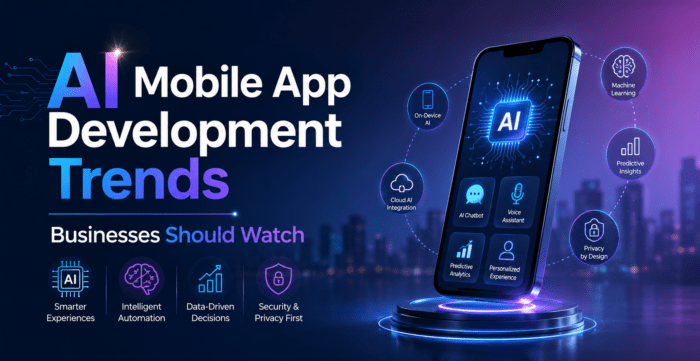
9 AI Mobile App Trends Worth Your Attention In 2026
Here are the nine ongoing and latest mobile app development trends that every IT business needs to stay updated with in the fast evolving tech era.
1. On-device AI is replacing the cloud round trip
Why it matters: every request that stays on the phone is one you’re not paying cloud compute for.
For years, “AI in an app” meant sending a request to a server, waiting a beat, and getting an answer back. That round trip cost time and money on every tap. Now a growing share of that work happens right there on the device and it’s measurably faster. On-device processing can cut response time by 30 to 50% compared to the old cloud method.
If you’re testing this for the first time, start small:
- Search suggestions and autofill
- Basic product or content recommendations
- Anything where speed matters more than deep reasoning
Save the heavier, more complicated AI work for the cloud, where you’ve actually got the horsepower to run it properly.
2. Apps are starting to take action, not just give suggestions
This is agentic AI, and it’s the trend generating the most noise right now. Instead of telling a customer what they should probably do, the app just does it. Reschedule the delivery, reorder the low-stock item, and books about the follow-up without five taps to get there. For a customer, that’s a real leap in convenience.
But here’s the gap nobody puts on the pitch deck:
Roughly two-thirds of enterprises have experimented with an AI agent like this. Fewer than a quarter has gotten one running reliably in daily production.
Everyone’s testing. Almost nobody’s shipped it and walked away without someone quietly babysitting it in the background.
3. Personalization has stopped being optional
Sticking someone’s first name in a subject line used to count as personalization. Not anymore. Two numbers explain why this matters more than most businesses realize:
- 71% of consumers now expect a personalized experience from the brands they use
- 76% say they get genuinely frustrated when they don’t get one
That frustrations costs money. Those who do lure in an average of 40% more revenue than those who don’t; savvy personalization efforts can boost ecommerce revenue by as much as 10% to 15% and reduce acquisition costs by up to 50%.
The good part? You probably don’t need new data to act on this. What someone browsed last week, what they left in a cart, what time they usually open your app, that’s already sitting in your systems, mostly unused.
4. In-app support is quietly becoming AI’s biggest win
While everyone argues about flashy agent features, the boring stuff is where the real return sits. Gartner’s research projects that agentic AI will resolve 80% of routine customer service issues autonomously by 2029, cutting operating costs by around 30% along the way.
You don’t have to wait three years for a smaller version of that payoff. Order status, appointment changes, basic troubleshooting, that’s where an in-app assistant earns its keep fastest, and with the least risk of embarrassing anyone in front of a customer.
Quick gut check: if your support team answers the same five questions all day, that’s exactly where to start.
5. Voice and multimodal input are showing up where typing gets in the way
About half of mobile users report using their voice assistants frequently, and that’s on the rise as voice recognition is now better at understanding accents and background noise than ever before.
Try this one, and it’s easy to get wrong – here’s the one rule to follow:
Add voice only if your customer is genuinely hands-busy, driving, cooking, working a warehouse floor. If that moment doesn’t exist for your users, skip it. Nobody’s asking to talk to your invoicing app.
6. Predictive nudges are replacing reactive notifications
The old model: customer does something, app responds. The new model flips around, the app notices a pattern and reaches out first. A few examples worth stealing:
- A subscription about to lapse
- A cart sitting untouched for two days
- A reorder window quietly approaching
While agentic AI is more attention-grabbing, it may result in greater value for the mid-size clients since it doesn’t have to make decisions on their behalf. It just has to pay attention and say something – it’s a safer starting point.
7. No-code and low-code AI tools are shrinking build timelines
It is not imperative to know whether an AI feature is worth doing properly after 6 months of development. For non-technical teams that need to prototype flows powered by AI but cannot commit to real budget, a number of new options have emerged.
The practical move: build the cheap, rough version first. Watch what customers actually do with it. Save the fully engineered, expensive version for the ideas that prove themselves.
8. Privacy-first AI is becoming a selling point, not just a compliance box
On-device processing doesn’t just save on cloud costs, it keeps more customer data off your servers entirely. That matters more every year as regulation tightens, and customers get pickier about who’s holding their information.
Something worth noticing: businesses that can honestly say “we process this on your device, not our servers” are starting to use that line in their marketing, not just bury it in a privacy policy nobody reads.
9. Agent fatigue is already setting in and that’s useful information
Here’s the number that should make you pause before greenlighting an “AI agent” feature:
Gartner predicts more than 40% of agentic AI projects will be canceled by the end of 2027 and not because the AI itself failed.
Their researchers point to three specific causes: costs that spiraled past budget, business value nobody could clearly define, and risk controls treated as an afterthought. Most of these projects don’t die in a lab. They die in a budget review, when someone finally asks what it actually delivered and nobody has a clean answer.
Before you build one: define what success looks like, and who’s accountable when it gets something wrong. Do that before a single line of code, not after your first angry customer email.
Conclusion
You don’t need all nine of these. You need a way to decide which ones are worth your money right now. Before approving anything AI-related, ask three questions:
- What specific problem does this solve for a real customer, not what does it make theoretically possible?
- What does it cost to run at your actual volume, not the demo numbers an agency showed you?
- Who’s accountable if there is something wrong in front of a paying customer?
If nobody in the room can answer all three cleanly, that’s worth more than any pitch deck. Pick one workflow your customers already complain about and put AI there first, support, order tracking, scheduling, whatever it is for you.
It’s not about having the longest list of features that will come across better than companies this year. They were the ones who decided on 2 or 3 things that actually mattered and were able to put those things into practice appropriately while everybody else was still arguing about trends to follow.
It’s not about AI at all, really. It’s about focusing on when your customer’s using your app. It’s about paying attention to the one moment where your app is the easiest app they use or the most annoying to use. If done at the right time, the right label to affix to the technology behind it counts for almost as much as people imagine.