AI-Powered Voice Agents: 24/7 Customer Support
Key Takeaways
- AI-powered voice agents use conversational AI and NLP to deliver near-human interactions beyond traditional IVR systems.
- 24/7 availability improves customer satisfaction, lowers costs, and strengthens loyalty by handling high volumes of routine requests.
- Adoption is strongest in e-commerce, banking, healthcare, and government services, where speed and accuracy are critical.
- While highly effective, AI voice agents still have limitations in handling complex language, emotions, and nuanced conversations, which require seamless human handoffs.
- The future points to greater personalization, empathy, and accessibility, redefining how businesses and customers communicate.
What Are AI-Powered Voice Agents?
AI-powered voice agents are digital systems that leverage cutting-edge artificial intelligence to interact with users using natural language. Unlike traditional automated systems that rely on strict scripts and limited responses, modern voice agents are built upon conversational AI and advanced natural language processing (NLP). This core technology allows them to understand, interpret, and respond to human speech in a near-human way, making interactions seamless and intuitive.
Today’s conversational AI platform for businesses integrates these capabilities and more, delivering adaptable, scalable, and intelligent virtual assistants that can engage, solve problems, and provide valuable information without supervision. Key features, such as contextual awareness, intent recognition, and the ability to process vast linguistic variations, differentiate these AI voice agents from legacy bots and basic IVR systems.
The Rise of 24/7 Digital Customer Support
Customer expectations have transformed in the digital age, with more people now demanding instant support regardless of the time of day. This shift has triggered a major movement toward always-on service, fueled by AI voice agents that never need breaks or sleep. Brands like banking institutions and e-commerce giants have deployed AI-powered voice agents, enabling customers to resolve issues or get answers after hours—something previously hard to scale with human labor.
The result is a significant improvement in customer satisfaction rates, as always-available digital agents minimize wait times and provide a consistent quality of service. This perpetual availability is now considered a mark of premium customer experience, boosting retention and improving overall engagement across sectors.
How Around-the-Clock Availability Impacts Business
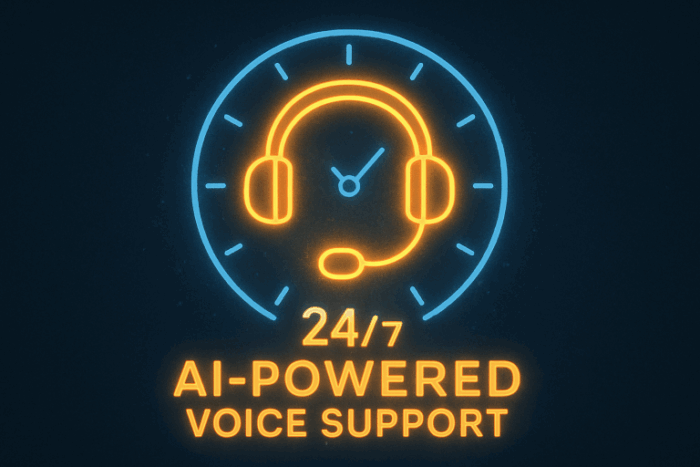
24/7 AI voice agents empower businesses with notable advantages: operational efficiency, reduced costs, and stronger customer loyalty. By managing high volumes of routine inquiries and automating repetitive tasks, these solutions free up human agents for more complex issues. Companies operating globally quickly recognize the benefit of serving customers across time zones without the need for increased staffing or overtime costs.
Always-on support is also a powerful differentiator in crowded markets. Organizations that ensure their AI-driven voice channels are available anytime—anywhere—gain a clear competitive advantage, positioning themselves as truly customer-centric in an era where convenience and immediate assistance often drive purchasing decisions.
Industry Applications: Who’s Using AI Voice Agents?
Industries leading the adoption of AI voice agents include e-commerce, banking, and healthcare, where fast, accurate support is mission-critical. For example, retailers have implemented voice agents to handle order status inquiries and returns, while banks use them for account management and fraud detection. Hospitals and clinics rely on AI agents to assist with appointment scheduling, triage questions, and prescription refills—improving outcomes and patient satisfaction.
The positive outcomes extend to the public sector, where government agencies deploy AI-powered hotlines for everything from public health updates to municipal services, ensuring citizens receive prompt support without long phone queues. Notable success stories across sectors highlight improved customer engagement, operational efficiencies, and measurable ROI.
The Role of Conversational AI in Shaping Human Interactions
Conversational AI voice agents are transforming how people interact with technology. As humans become more accustomed to speaking naturally to devices, the line between digital and human communication continues to blur. For straightforward, informational tasks, many customers prefer the anonymity and convenience provided by AI assistance, especially when it means skipping long waits or avoiding social anxieties associated with certain types of inquiries.
Emerging research points to new trends in digital empathy, with AI systems increasingly capable of detecting and responding to emotion in voice, inflection, and language. This focus on rapport-building helps bridge the emotional gaps in technology-mediated communication and fosters a sense of connection, which is vital as reliance on digital service channels grows.
Challenges: Can AI Voice Agents Really Cover Every Situation?
Despite significant progress, AI-powered voice agents face notable challenges. Current limitations include full comprehension of complex language and slang, the subtlety of emotional cues, and maintaining context in long or nuanced conversations. While these agents excel at routine requests, effective support systems must always provide a way to escalate issues to human agents—a process that should be seamless and transparent.
What Does the Data Say? Trends and Research Insights
Recent industry data shows customer demand for 24/7 AI support has surged, with a Gartner report projecting that by 2025, 80% of customer service and support organizations will leverage generative AI. Surveys reveal that immediate resolution and after-hours availability are now among the top drivers of customer satisfaction, surpassing even traditional metrics such as friendly service or brand loyalty in some cases.
Statistical analysis suggests that businesses that are not providing AI-enabled, always-on channels risk losing customers to competitors that embrace the technology. As AI solutions mature, positive trends in adoption, customer trust, and business outcomes are all but guaranteed to accelerate.
Best Practices for Adopting Voice Agents in Your Organization
- Process Identification: Analyze business workflows to pinpoint repetitive tasks and predictable customer queries ideal for automation.
- Blended Support: Maintain a seamless handoff between AI agents and live staff, ensuring complex needs receive human expertise while maximizing efficiency for common requests.
- Training & Collaboration: Equip teams to work in harmony with AI systems—teaching agents to manage escalations, monitor performance, and provide feedback on AI interactions.
- Performance Measurement: Use analytics and customer feedback to continually optimize both voice agent and human agent performance, refining the system for evolving expectations.
The Road Ahead: Imagining the Future of AI Voice Support
The next era for voice agents will be defined by greater personalization, empathy, and integration across digital touchpoints. Innovations will likely make AI-driven interactions indistinguishable from humans, reimagining brand-customer relationships around anticipation, accessibility, and inclusion. The expanding role of AI will help close accessibility gaps, providing vital support for those with disabilities, language barriers, or limited digital literacy.
As AI and human collaboration deepens, businesses that prioritize ethical AI, transparency, and continuous improvement will set new standards for customer engagement in a world where voice truly never sleeps.